9.24.2006

The Soft-Petal SBC Calvinists

The CT article on Calvinism in the Southern Baptist Convention is now online.

My favorite quotation was "We're not the kind [of Calvinists] who are off in a Grand Rapids [read: ethnic Dutch] ghetto crossing our t's and dotting our i's and telling the world to get their act together. We're in the New Orleans slums with groups like Desire Street Ministries, raising up black elders through Reformed theology from 9-year-old boys who had no chance." (Although, I was under the impression that Desire Street was actually a PCA mission.)

But notice that the predominant attitude among these SBC Calvinists is that as it concerns spiritual life, gospel truth is "best," but optional. This comes across in Mohler's panel discussion with Patterson at the SBC pastor's conference this year. The gospel will only shake things up in the SBC when it is understood that it should divide churches. Perhaps some of these SBC Calvinists will embrace the perspective of Spurgeon who famously said,
"And what is the heresy of Arminianism but the addition of something to the work of the Redeemer?... [T]here is no such thing as preaching Christ and Him crucified, unless we preach what nowadays is called Calvinism. It is a nickname to call it Calvinism; Calvinism is the gospel, and nothing else. I do not believe we can preach the gospel, if we do not preach justification by faith, without works; nor unless we preach the sovereignty of God in His dispens[ing] grace; nor unless we exalt the electing, unchangeable, eternal, immutable, conquering love of Jehovah; nor do I think we can preach the gospel, unless we base it upon the special and particular redemption [ie, "limited" or definite atonement] of His elect and chosen people which Christ wrought out upon the cross..."
The gospel cannot be optional. Biblical grace is not a secondary, inessential teaching only for the mature. It is the foundation. And there is not a true church apart from the profession of this gospel.

The research department of LifeWay, the "products and services" provider of the SBC and publishers of the Holman Christian Standard Bible, has conducted a survey of SBC pastors and found that about 10% consider themselves Calvinist, with (surprisingly) no present correlation to age of the pastor. With about 42,000 congregations and 10,000 missionaries, a conservative estimate would equal about 5,200 self-identifying SBC Calvinist pastors. Of course, the percentage and correlation with new (younger) pastors may be growing. A similar survey in a decade would be enlightening.

On another note, I suspect that some SBC'ers and other "Evangelicals" have been attracted to the Reformed faith, not only by its explicit teaching and meaning for church life, but also by its implications for worldview and approach to culture. Reformational Baptist David Naugle is the "Piper" or "Mohler" (ie, main promoter) of neocalvinism in Baptist and Evangelical circles. Read his pdf Intro to Reformational Worldview.


9.18.2006

Framing The Debate

How could I disagree with John Frame on almost every Reformed in-camp debate? I think he has been wrong about Dooyeweerd*, wrong about the regulative principle of worship, and wrong about the nature of doctrinal controversy itself, and many other important issues. I hope to offer my reasons for disagreement with him on these issues in the future. However, in a recent article he attempts to characterize two opposing sides in a debate about the Christian approach to civil government. I want to touch on this briefly, because it has culture-wide implications.

The larger question at stake is whether there is a distinctively Christian (ie, Calvinistic) perspective on and approach to culture. In other words, 1) is it possible to understand and do culture Christianly. If so, then 2) how and where can we discover, learn, and/or develop such an approach? And 3) what exactly is that approach, and what makes it distinctively Christian? Those who answer the first question in the negative must still address "how, then, shall Christians live culturally?" (if not in a distinctively Christian way). But those who answer the first question affirmatively (as most, if not all, genuine Calvinists do) may answer the second in reference to God's revelation.

Revelation is given in two basic kinds, often called "general" and "special" revelation. A lot can be said about these two kinds of revelation, and what is said has crucial implications for the third question. But basically, general revelation is what God reveals through the created temporal order, and special revelation is what God more particularly reveals by (what we now know as) Holy Scripture. The relationship between general and special revelation is decisive for the second and third questions too.

In any case, Frame says that there are Kuyperians and then there are Klineans. Klineans, he says, do not believe in the necessity of special revelation for civil government (nor, one can infer, for "Christian culture"). Now, as both a Klinean and a Kuyperian (a Kuyperian-Klinean, or vice versa, if you will) I cannot agree with Frame's mischaracterization. Kline is himself both "Vosian" and "Vantilian". Certainly there are some differences between Vos' and Kuyper's views, but not disagreements on this issue. And Kline follows both Vos and VanTil in agreement with Kuyper concerning the sufficiency of general revelation, the necessity of special revelation, and the correlation between both kinds of revelation. Dooyeweerd, by the way, also agrees with Kuyper, Vos, VanTil, and Kline on this.

The specific meaning of sufficiency of general revelation, necessity of special revelation, and their correlation, and how they are articulated is crucial. I hope to address this in detail at some point. There are, of course, differences and disagreements between the views of these important thinkers, and some of those are relevant to this debate. Historcial development of the issues should also be taken into account. But Frame's (mis)characterization is inaccurate and is a detriment to clarity and to moving the discussion forward**. Some comments on Hegeman's blog [1, 2].

9.09.2006

In The Papers

This week, The Baltimore Sun paper did an article about blogging. Who do they think their audience is that they frame blogs as something new? I mean, if your own mayor has had one for over a year, it really can't be "news" anymore. Well, I suppose regular print-newspaper reading types are less likely to be familiar. But I think they could have just assumed familiarity and written about local bloggers.

In any case, poet and friend, Salimah Perkins, un-anonymotizes herself, being interviewed for the article. Listen to the Sun mp3 podcast interview with her HERE. (I'm genuinely impressed with her interviewee skills.) The Sun, surprisingly, has a number of podcasted features.

9.03.2006

Heretical Friends

I recently met neopelagian christi-anarchist community developer Dave Andrews. We had some good discussion, and later he gave a presentation on his centered-set approach to community.

In the mid 70s Paul Hiebert popularized the concepts of bounded-set and centered-set definitions of social groups. Roughly, the bounded-set defines group membership by position relative to a boundary. The centered-set defines group membership by movement relative to a center. I think both forms of definition are helpful in describing Christian life and community, my objections are to a theology that defines people as other than ("original and total") sinners, and Christ as other than ("substitutively atoning") Savior.

Nevertheless, I look forward to benefiting from Dave's writing on community work [1 & 2].

8.30.2006

Somewhere In Some Library

My article, entitled Dooyeweerd's Societal Sphere Sovereignty: a theory of differentiated responsibility, is now available at the Peace Palace library here. It is also available online in pdf HERE, from the June 2006 Griffin's View International and Comparative Law Journal site. It is a revision of the short paper I wrote this year.

In other news, you can listen to Dr. Henk Geertsema's October 2005 lecture on Dooyeweerd's transcendental critique on this site. The recording -in two parts- was made at the Vrije Universiteit, Amsterdam, by fellow student Xiaomei Ge. The lecture was given in the International Masters in Christian Studies of Science and Society program (IMCSSS) in light of our reading of the first two chapters of Dooyeweerd's In The Twilight Of Western Thought. The recording is made available with the permission of Dr. Geertsema under the condition that exclusive responsibility and all liability remain with me.

8.26.2006

Worth Reading

Officially, I don't do these "questionnaires". But I enjoyed reading the answers of others (practically everyone has done it already), and I was tagged by Steve and Scott, and figured I could take liberties with the format. So, here are a few comments about books.

G.I. Williamson's study on the Westminster Confession of Faith definitely changed my life. It's difficult to imagine what kind of person I might be today apart from the influence of this book on my faith. It's probable that I would have been just as argumentative, but I would have wasted my life arguing about less important things, or for less biblical views.

John Bright's The Kingdom Of God is one of the few books I've read more than once. I've read parts of books (particularly non-fiction) over again. But this book was definitely worth multiple cover-to-cover readings.

There are far too many books I've been intending to read. In a non-academic genre, I need to read something by Sarah Vowell. I'm familiar with her work from hearing shorter pieces over the radio. I might be her biggest fan who has never read any of her books. Academically, I really need to read something by Richard Muller; perhaps this one especially. And fiction-wise, I have a hard time persevering through novels (although audio is just fine, I can listen for hours), so short story is my preference. Anthologies are good.

You may be interested to know that I pretty much laugh and cry no matter what I read. Honest. I have both laughed and cried while reading philosophy texts. What can I say? I'm easily moved.

I don't (officially) "tag" them, but I would be interested to read Paul's, Jeff's, Salimah's, Eric's, and Julie's responses to the typical 9 questions. Paul devours books (so it seems) like Hades does the reprobate. The others are perhaps my most "literary" friends.

8.20.2006

The Blogging Dooyeweerdians
or "blogosphere sovereignty"?

My friend, Scott Kennedy, is utilizing Dooyeweerdian modal aspects to tag his blog posts. I think this is totally fantastic. I don't use tags myself, and such an application would probably never have occurred to me. But I hope his endeavor is a success and that others try it out.

Modalities (or aspects) are highly abstract "categories." They are fundamentally hows or ways (not whats or things). They are the "hows" of meaning. Created reality, all existence, is meaning. Things don't have meaning, they are meaning. That sounds strange, but it means that, as created, the being of this universe is utterly dependent on its Creator. Being is meaning because it both refers to God and expresses His power. The modalities are theoretically irreducible "modes" of temporal being and experience, that is to say "of the way reality means."

Now, as the highly abstract categories that they are, modalities may not seem to be the best "taxonomy" for blog post tagging. Most topics discussed in any given blog entry cover a wide range of interconnections, or what might be called "modal analogies." But even these sorts of analogical concepts are still quite abstract. Many things one would talk about in a blog are the concrete things of "every day" experience. One might talk about a vacation trip, and the paintings viewed in a museum, and the friends who came with, and the foods tasted, and so on. One might even talk about the paper one's writing. But these are all concrete things, not abstractions.

However, each of these concrete things may be associated with some "primary characteristic" or other. And such primary characteristics, however discerned, can be associated with some particular related modality. Blog topics classification is not a theoretically precise science, and there's no reason it should be. But the possibility of relating such topics to Dooyeweerd's profound theoretical matrix seems to hold promise of providing a diverse-enough-to-be-flexible, yet concise-enough-to-be-systematic solution for blog metadata. Who woulda thunk it?

Anyway, let me take this opportunity to list the several Reformational (aka Dooyeweerdian) and/or Neocalvinist (aka Kuyperian) active bloggers from my sidebar. In part, I mention these blogs to find out who else I can include. So, if I've left you out, let me know!
Macht Beheersing
Mark Bertrand
Nathan Bierma
Steve Bishop
Byron Borger
Joe Carter
Jeff Cavanaugh
Sander Chan
Nevada Epiginoskein
Cal Fox
Bill Gram-Reefer
Rudi Hayward (new blogger!)
Dave Hegeman
Andrea Hensen
Kenn Hermann
Ben House
Brian Janaszek
David Koyzis
Keith Martel
Cynthia Nielsen
Paul Otto
Nancy Pearcey
The Philologous
Theo Plantinga
Russ Reeves
Owl Refwrite
Paul Robinson
Jamie Smith
Gideon Strauss
Steve Veldkamp
Greg Veltman
Graham Weeks

Again, if I mistakenly left you out (and you've posted in the past month or so), or if you're only a neocalvinist in my dreams (I mistakenly included you), be sure to leave me a comment and I'll correct the list.

8.17.2006

To Be Clear

One difference (among many) between academic seminars and personal relationships is that there should be a mutual love-commitment between persons in the latter case. Nevertheless, what Lonergan said in the Halifax Lectures on Insight (1958) applies to interpersonal communication generally, I think.
"The more you talk with one another and throw things out, the more you probe, and the more you express yourself spontaneously, simply, frankly, not holding back in fear of making mistakes, then the more quickly you arrive at the point where you get the thing cleared up."
--Understading and Being, p.18
I read this to my friend, Karel, and he said "Ah, yes. Social hermeneutics."

8.09.2006

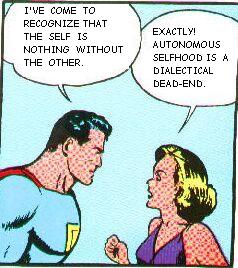
Re-turning To Ones Self With The Other
:how I rewrote the themes in my head

A friend informed me that Superman Returns was now showing at a cinema near me here in Amsterdam... of course, I went to see it immediately. There are other things one could say about the movie, but I want to tell you what it was about and what it should have been about.

What it was about:
The justification of our no-fault therapeutic culture of mid-life crisis, illegitimate parentage, and absentee fatherhood (with a subtext of modernist (erroneous) faith in progeny and the basic goodness of humanity & an underdeveloped postmodern ambiguity about the potential destructive/salvific power of technology). In other words, typical Hollywood garbage.

What it coulda-shoulda been about:
Needing the other, and the deconstruction of the autonomous selfhood (as resolution of the freedom-determinism dialectic within personal identity).
Let me break it down for you.
Lex is the banally evil actual Nietzschean Übermensch who defines his own power-morality, resenting "the other" as limiting his own would-be absolute autonomy.

Clark is in the process of "becoming oneself," in a continuous existential coming to terms with his own identity. But now he realizes this can no longer be facilitated by an appeal to irresponsible destiny, nor to autonomous self-definition, but rather only in a recognition of ones finitude and situatedness with the other.

Having re-turned from his last attempt at being an autonomous (Kryptonian) self, finding "nothing there but a wasteland," he turns back to the other (the earth-world, personified in Lois). In conflict with Lex (a sort of alter-ego) he recognizes his need of the other, as much as the other (as a self) recognizes her need of him in order to really discover their-own-selves in them-self in a mutual relation (love).

Of course, to fill out this theme in a film would require genuine dialog.

Note : be sure to see comments below. Leopoldtulip ably challenges my interpretation and prefered alternative. But I now see a more substantial connection regarding the "was about" and the "wasn't but shoulda been" about. In brief, the absent father is actually Autonomy, and Hollywood is in denial about it. Lois is the Real Uberfrau!
Recommended Reading.

7.31.2006

Office Hours

I don't have web access in my new apartment (yet?), and working at home has become too isolating. Although I can get to the university easy enough when I need to, I decided to find a cafe nearby with wifi. For today deBalie is my office, but I suppose I'll have to find multiple alternatives to avoid annoying the staff at any one place.

In other news, there is a nice piece about Gordon in the Sun.
Also, I made a second response on DeRegnoChristi blog here.

thesis happenings: pressing on... at the moment concentrating on analysis of Lonergan material.